Best Balls in Idle Breakout: All 6 Ranked with Tier List
There are six balls to unlock when you play Idle Breakout free, and no single one wins the whole game. Cannonballs carry most of your run, plasma balls clear levels fastest, sniper balls aim themselves at the nearest brick, and basic balls quietly become the strongest thing in the game once you own one specific skill. This guide ranks all six, shows what each one costs, and gives you a working setup for the early, middle and late game.
Quick Answer: Idle Breakout Ball Tier List
| Tier | Ball | Why it sits here |
|---|---|---|
| S | Basic Ball | Only with the final basic skill, where power multiplies by how many you own |
| S | Cannonball | The best raw damage for the money across most of a run |
| A | Plasma Ball | 25% splash damage means whole levels fall at once |
| A | Sniper Ball | Aims at the nearest brick after every wall bounce, and hits black bricks without spending a skill point |
| B | Scatter Ball | Strong damage output, poor aim, needs skills to shine |
| C | Poison Ball | A support ball, not a damage ball. Buy one or two |
All 6 Balls at a Glance
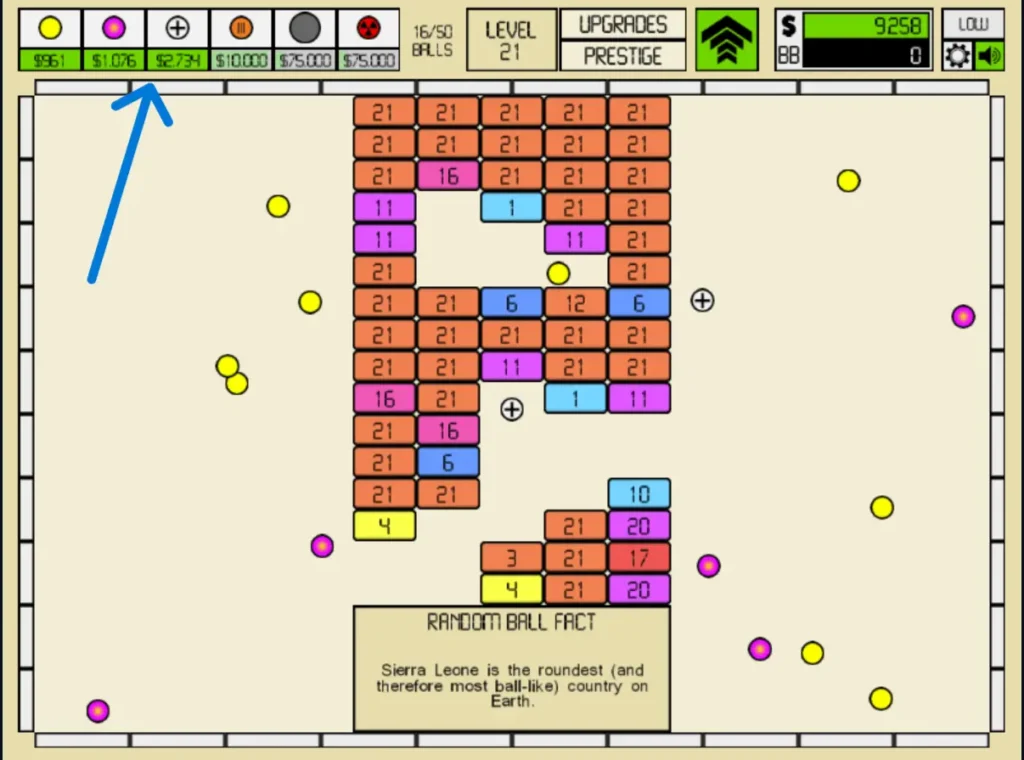
| Ball | First ball costs | Each extra ball costs | Base speed / power | What it does | Its two upgrades |
|---|---|---|---|---|---|
| Basic Ball | $25 | +50% | 1 / 1 | Standard ball, bounces and breaks bricks | Speed (max 10) and power |
| Plasma Ball | $200 | +40% | 2 / 3 | 25% splash damage to nearby bricks | Range (max 7) and power |
| Sniper Ball | $1,500 | +35% | 4 / 5 | Aims at the nearest brick after every wall bounce | Speed (max 10) and power |
| Scatter Ball | $10,000 | +35% | 3 / 10 | Spawns single hit mini balls at 50% power | Extra balls (max 10) and power |
| Cannonball | $75,000 | +30% | 4 / 50 | Smashes through bricks it breaks | Speed (max 15) and power |
| Poison Ball | $75,000 | +25% | 5 / 5 | Infects bricks so they take double damage | Speed (max 15) and power |
There is also the Snow Ball, which is not a ball you buy. It is one of five power-ups, and you earn a power-up pick every 600 bricks you break. For 30 seconds it gains power and speed with every bounce and aims at the nearest brick after each wall bounce.
Every Ball Ranked, and When to Actually Buy It
Basic Ball: the sleeper that ends up strongest
The basic ball starts at $25 and does nothing clever. It bounces, it hits, it moves on, exactly the loop Atari built the original Breakout around in 1976. For most of the game it is the ball you buy because it is cheap, and the one you stop buying the moment plasma balls are affordable.
Then there is the last skill in the basic column: basic ball power multiplies for every basic ball you own. That flips the maths completely. Each basic ball you add makes every other basic ball hit harder, so the damage curve bends upward instead of adding in a straight line. Players who have tested it put the crossover at around 40 to 44 basic balls, which is where a basic build overtakes an equivalent spend on cannonballs.
The catch is price. Each new basic ball costs 50% more than the last, the steepest climb of any ball, so a 40 ball stack is a late game move, not an early one.
Buy it when: you are starting a run, or you own the final basic skill and can afford to stack 40 or more.
Cannonball: the damage workhorse
Cannonballs cost $75,000 for the first one. When a hit breaks a brick, the cannonball keeps going instead of bouncing, so one shot can clear several weak bricks in a line. If the brick survives the hit, it bounces like any other ball.
The gap in raw numbers is bigger than people expect. A cannonball starts at 50 power against a sniper ball’s 5, and every power upgrade adds 25 where a sniper’s adds 5. That is five times the damage gained per upgrade, which is why cannonballs carry the middle of most runs. Their speed upgrade also goes higher than most, up to 15.
The weakness is placement. A cannonball goes where physics sends it, so on a nearly empty level it can spend seconds hitting nothing.
Buy it when: you can afford several, not just one. A single cannonball at $75,000 is worse value than the same money spent on plasma.
Plasma Ball: the fastest level clearer
Plasma balls cost $200 and deal 25% splash damage around whatever they hit. On a full level, every hit is really several hits, so plasma clears the screen faster than anything else and keeps your money per minute climbing.
Plasma is also the only ball whose second upgrade is range rather than speed, which widens the splash rather than making the ball move quicker. Its speed stays fixed at 2. The plasma skill column holds Splash damage from Plasma Balls 4X, which lifts the splash from 25% to full power and makes plasma far stronger on crowded levels.
Players who have compared damage against normal bricks with all ball skills unlocked usually put plasma at the top of the list, ahead of cannon and scatter. Against single targets like bosses it is only strong on the bosses that happen to take double plasma damage.
Buy it when: immediately after your first handful of basic balls, and keep adding them all run.
Sniper Ball: the self-aiming ball that hits black bricks for free
Sniper balls cost $1,500 and turn toward the nearest brick every time they bounce off a wall. They start with a base speed of 4 and base power of 5, and their first upgrades run $7,500 for speed and $8,000 for power.
Two things make snipers special:
Their weakness is damage per dollar. Snipers are reliable, not powerful, and a pure sniper build stalls in the late game.
Buy it when: you are clearing black bricks, fighting boss bricks, or tired of watching balls miss the last brick on a level.
Scatter Ball: big output, bad aim
Scatter balls cost $10,000. Every time one bounces off a wall, it throws off single hit mini balls at 50% power, two at first and up to ten with upgrades. Their upgrades are power and the number of mini balls, not speed, so the scatter ball itself stays at speed 3.
On a packed level, scatter output is genuinely high. The problem is direction. Mini balls fly where they like, and on a level with two bricks left most of that output goes into empty space.
Two skills change the picture: one doubles mini ball damage, and the scatter column also holds the skill that doubles power up duration to a full minute, which is useful for every build in the game, not just a scatter one.
Buy it when: you are pushing through dense levels quickly, or you want the power up duration skill at the bottom of that column.
Poison Ball: a support ball people misread
The poison ball is the sixth and last unlock, also $75,000. When it hits a brick, dots appear on the brick to show it now takes double damage from everything.
That sounds enormous, and it would be, except the effect does not stack. One poison ball infects the brick, and the tenth poison ball adds nothing on top. Poison is not slow, though. Its base speed of 5 is the highest of all six balls, and its power upgrades are the cheapest in the game at $50,000.
Two skills in its column change how it plays: poisoned bricks take damage over time, and poisoned bricks slowly infect nearby bricks. With both, a couple of poison balls can keep a whole level infected. One thing poison cannot do is infect boss bricks, so it adds nothing to the double damage effect in boss fights.
So poison earns a slot, not a build. Two poison balls keeping targets infected while cannon or plasma does the damage is correct. Twenty poison balls is money set on fire.
Buy it when: you already have a real damage core and want everything else to hit harder.
Best Ball Setup for Each Stage of the Game
Early game, before level 100
Buy a handful of basic balls, then move to plasma as soon as you can and keep buying them. Do not hoard money waiting for something expensive. Money sitting in the bank breaks no bricks.
A simple split that works: basic balls until plasma is affordable, then plasma as the main damage with basic balls filling gaps.
Mid game, black bricks and early bosses
Now you need two things at once: clear speed for money, and single target damage for black bricks and bosses.
Late game, after skills are unlocked
Once you own the final basic skill, basic balls stop being filler and become the build. Stack them past 40, keep plasma for clear speed, and keep snipers for anything that needs precision.
How Many Balls Can You Have?
Idle Breakout caps your total ball count. It starts at 50, and the only way past that is gold spent on the prestige upgrade that raises the maximum. Each level of that upgrade adds 10 balls, up to 95 levels, so the absolute ceiling is 1,000 balls. Details on gold and resets are in the prestige guide.
Two related things worth knowing:
Upgrades: Power Goes Far, Speed Caps Early
This is the detail that quietly decides who has a good late game.
Each ball has two upgrade buttons. Power upgrades run a very long way, up to 9,999 base power per ball type, and the prestige power multiplier doubles that again with every level. Speed, range and mini ball count upgrades all hit a hard cap much sooner, so once a ball’s speed is maxed, all your extra money goes into power or into more balls.
| Ball | Base speed | Max speed from upgrades |
|---|---|---|
| Basic Ball | 1 | 10 |
| Plasma Ball | 2 | 2 (no speed upgrade) |
| Sniper Ball | 4 | 10 |
| Scatter Ball | 3 | 3 (no speed upgrade) |
| Cannonball | 4 | 15 |
| Poison Ball | 5 | 15 |
On top of that, the Ball Speed Increase prestige upgrade multiplies every ball’s speed, up to 10x. There is also a game-wide speed limit of 40, which rises to 60 with the speed limit skill. No ball can move faster than that limit, whatever its upgrades say.
That gives you a simple rule. Early on, speed is excellent value because it is cheap and a faster ball is more hits per second. Once speed caps out, the only way forward is power and quantity.
The Skills That Change This Ranking
Skill points come from beating boss bricks, one per boss. Each ball has its own column in the skill tree. Six skills matter enough to change which ball you should be buying:
Every column also has a skill that gives that ball a small chance of damaging all bricks at once. A full buying order for the tree is in the skill points guide.
Which Balls Are Best Against Bosses?
Boss fights use different maths, because a boss is one huge stationary target. Most bosses take double damage from one or two ball types and half damage from one or two others, and the very first boss, Block Head, has no weakness at all.
Snipers are the safe default since they keep aiming at the boss, cannonballs put out more raw damage, and plasma is excellent on the bosses that are weak to it. Poison is the one to leave out: it cannot infect boss bricks, so it only helps on a boss that takes double damage from poison balls. What you must not do is check nothing and buy twenty more of your favourite ball right before a boss that halves its damage. The boss by boss weaknesses are listed in the boss guide.
FAQs
FINAL THOUGHTS
The honest answer to which ball is best is that the order changes as you progress. Plasma early, cannon in the middle, basic at the end, snipers throughout for anything that needs precision, and poison as a two ball side dish. Keep your speed upgrades maxed while they are cheap, respect the 50 ball cap until gold lifts it, and never build so narrowly that a single boss can shut your whole setup down.